How to Integrate AI With Your Hospitality Standards (To Free Up Your Best People)
I was sitting in a bank lobby a few weeks ago, watching a branch manager: someone I know is a phenomenal "people person": spend forty-five minutes hunched over a computer screen. He was wrestling with a data entry error in a loan application. Meanwhile, three customers were waiting, glancing at their watches, feeling like they were just another number in a queue.
That manager wasn't being lazy. He was doing his job. But he wasn't practicing hospitality.
This is the friction point we’re seeing across every industry right now: from hotels to hospitals to high-street banks. We hire great people for their hearts and their intuition, and then we bury them under a mountain of "administrative "noise." We ask them to be hospitable, but we give them a workload that forces them to act like robots.
As we continue this 23-part series on the intersection of technology and human connection, we have to address the elephant in the room: AI. For some, the word conjures up images of cold, metallic replacements for human warmth. But at Legacy Edge Partners, we see it differently.
AI isn’t the actor on the stage. It’s the stagehand. Its job is to move the scenery and check the lighting so your best people can step into the spotlight and do what only humans can do: make someone feel seen.
The Difference Between Service and Hospitality
To understand how to integrate AI, we first have to get clear on the language. As I often say, service vs hospitality are two very different things.
Service is the technical delivery of a product. It’s the bank processing your check. It’s the hotel getting you a room key. It’s the nurse recording your blood pressure. Service is a task. It’s binary: it’s either done correctly, or it isn’t.
Hospitality, however, is how the guest feels during that process. It’s the sense of security the bank customer feels when they know their legacy is protected. It’s the feeling of being "home" when a guest walks into a lobby. It’s the comfort a patient feels when a nurse looks them in the eye and really listens.
AI is incredibly good at service. It’s terrible at hospitality.
When we integrate AI correctly, we aren't "automating hospitality." We are automating service so that we can unleash hospitality.
Taking the "Robot" Out of the Human
Most of our "best people" are currently spending 60% of their day performing tasks that a machine could do better, faster, and more accurately.
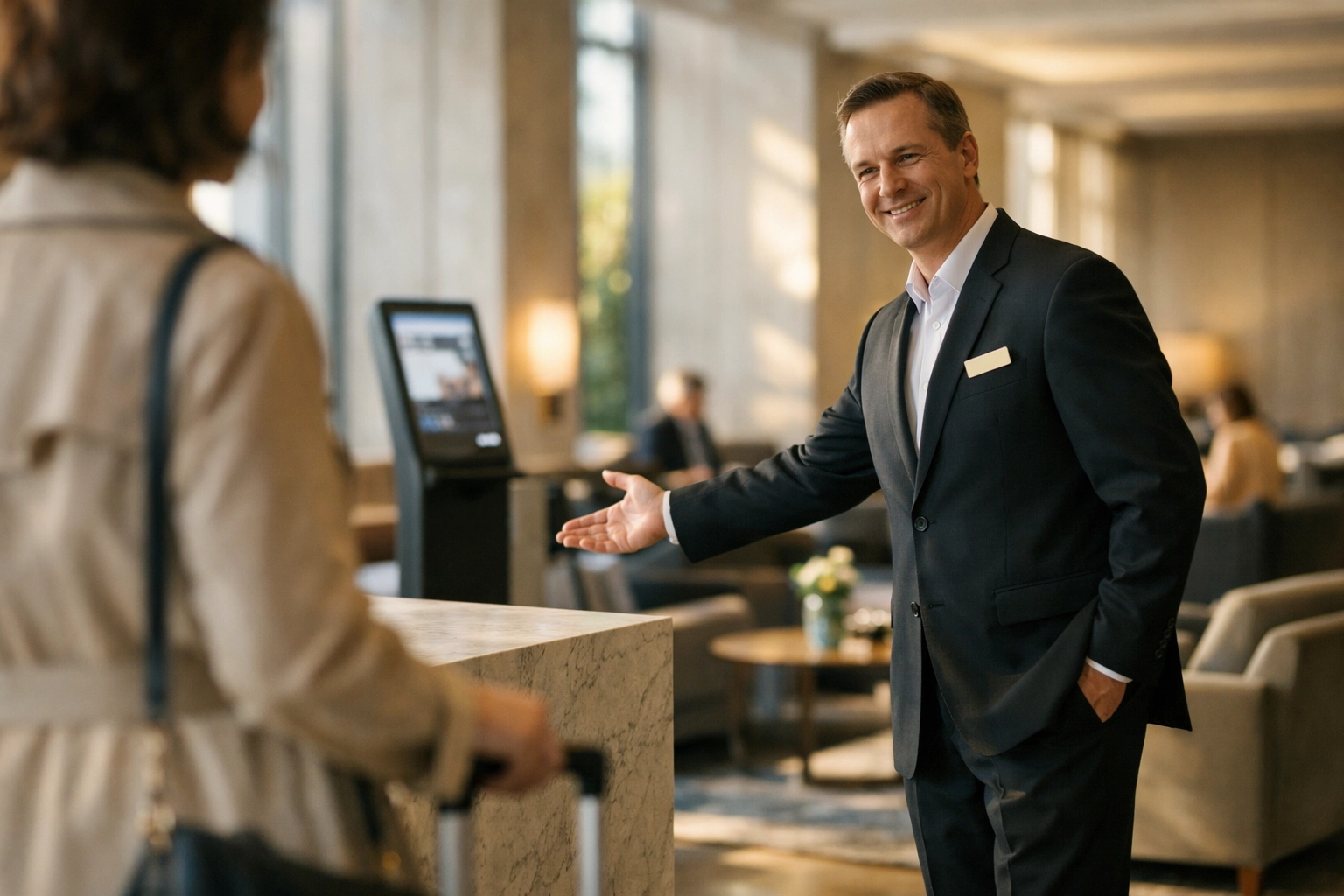
Think about the hospitality industry. If a front desk agent spends their entire interaction looking at a screen, typing in a credit card number, and verifying an address, they have zero "presence" left for the guest standing in front of them. They are performing a transaction, not creating a moment.
By integrating AI-powered check-in kiosks or mobile keys, we aren't removing the human. We are removing the transaction from the human. Now, when that guest walks through the door, the agent isn't a data entry clerk. They are a host. They can step out from behind the desk, offer a glass of water, and ask, "How was your flight?"
They can focus on the unforgettable moments that drive loyalty.
The same applies to banking. If a personal banker is freed from the manual labor of routine inquiries: checking balances, resetting passwords, or basic document gathering: through AI chatbots and automated workflows, they can spend their time on "high-value" hospitality. They can sit down with a family and talk about their long-term goals. They can provide the empathy and wisdom that a machine simply cannot replicate.
Operationalizing the "Stagehand"
So, how do we actually do this without losing the soul of the business? It starts by looking at your operations through the lens of Hospitality Mastery. Hospitality must be operationalized to scale.
Here are three areas where AI can act as the ultimate stagehand:
1. Low-Touch, High-Frequency Tasks
Identify the questions your team answers fifty times a day. "What time is check-out?" "How do I reset my banking PIN?" "Where do I park for my appointment?" These are "service" questions. When a human answers these for the fiftieth time, they often sound like a recording. Use AI-powered virtual assistants to handle these. It’s not about avoiding the customer; it’s about ensuring that when the customer does need a human, they get one who is fresh, engaged, and ready to help.
2. Predictive Maintenance and Operations
In healthcare and hospitality, the "unseen" moments matter. A broken AC unit in a hotel room or an equipment failure in a clinic is a service failure that creates a negative feeling. AI and IoT (Internet of Things) sensors can predict when a machine is about to fail before it actually does. When your maintenance team can fix a problem before the guest even knows it exists, that is "invisible hospitality." You’ve used technology to protect the experience.
3. Revenue and Data Management
In banking and hospitality, pricing and demand are constant stresses. Instead of having a manager spend hours every morning manually adjusting rates or analyzing spreadsheets, let AI handle the data crunching. AI can analyze demand patterns and competitor pricing in seconds. This frees your leadership to focus on employee engagement and culture: the things that actually move the needle on long-term growth.

The "Good Guy Advantage" in a Tech-Driven World
There is a temptation to use AI to cut costs by cutting people. That is a short-term play that leads to long-term irrelevance.
In a world where everything is becoming automated, human connection becomes a premium commodity. If you use AI to replace your people, you become a commodity. If you use AI to empower your people, you become a destination.
We call this the Good Guy Advantage. By playing the long game: investing in technology to support your staff: you create a culture where people actually want to work. And when people love where they work, guests feel it.
I’ve seen healthcare clinics use AI to transcribe doctor-patient notes. This allows the doctor to actually look at the patient during the exam instead of staring at a laptop. The "service" (the medical record) is handled by the machine, but the "hospitality" (the feeling of being cared for) is amplified by the human.
Why "Fine" is the Enemy of Integration
The biggest risk in integrating AI isn't the technology failing; it’s the human staff becoming complacent. When you free up your people’s time, what do they do with it?
If you automate the check-in process but your staff just stands around looking at their phones, you haven't improved the experience. You’ve just made it "fine." And as we know, fine is forgettable.
Integration requires a shift in leadership and training. You have to teach your team what to do with their newfound "presence." You have to train them on the "Hospitality Edge": how to read a room, how to anticipate a need, and how to create a memory.
Building Your Legacy Through Balance
The leaders who will be remembered: the ones who build a true Hospitality Legacy: are those who understand that technology is a tool, not a solution.
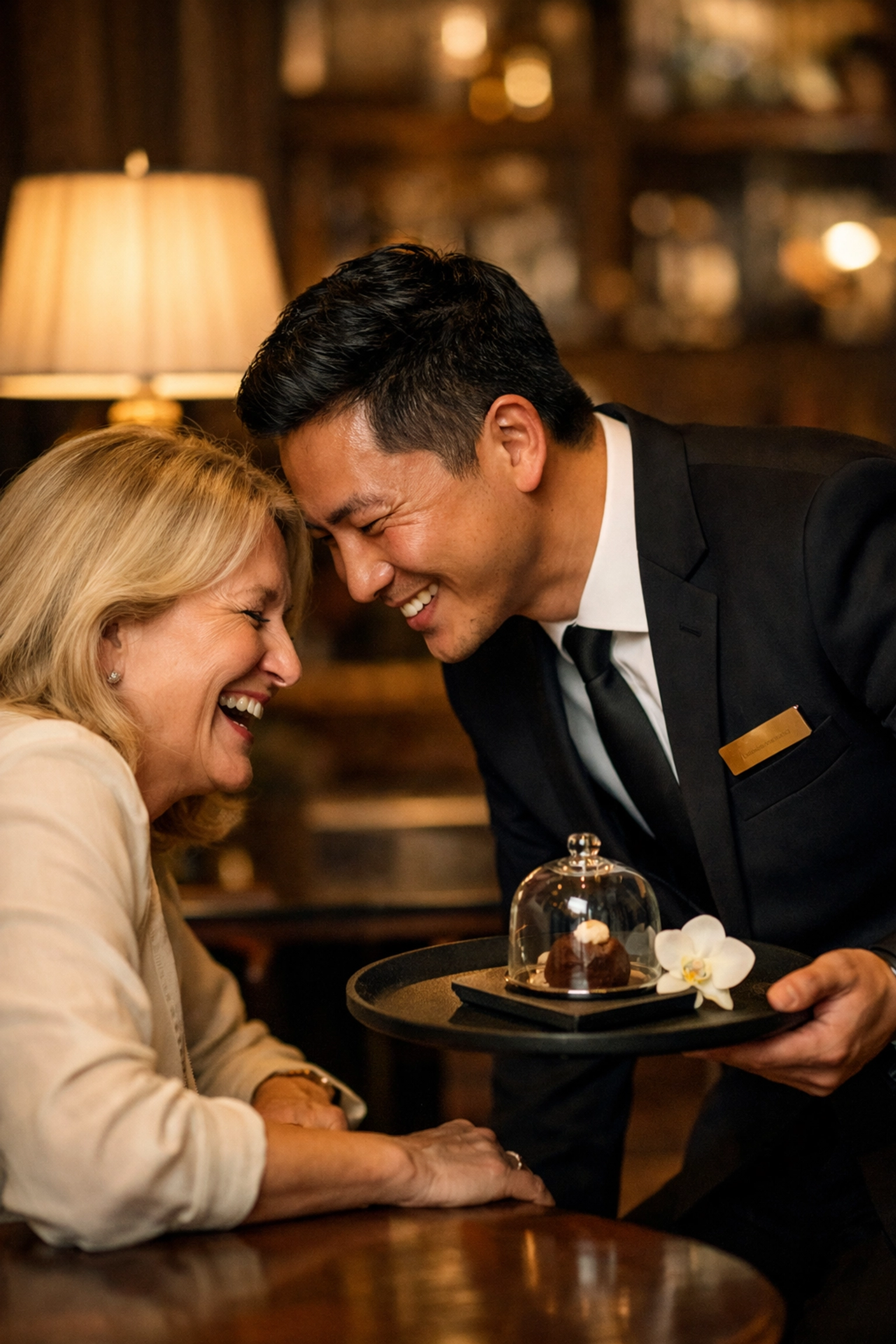
Your legacy won't be the AI software you implemented in 2026. Your legacy will be how your team treated people when they finally had the time to do it right. It will be the "unseen moments" where a bank teller noticed a customer was grieving and took five minutes to offer a kind word, because the machine had already handled the deposit.
It’s about using the "stagehand" to make sure the "people-first" mission of Legacy Edge Partners stays front and center.
If you are looking at your daily operations and feeling like your team is drowning in tasks, don't just hire more people to do more tasks. Look at where the robot conversation can actually help you become more human.
The soul of your business isn't in your SOPs or your software. It’s in the heart of your people. Use the tech to give them their heart back.
Reflection for the week:
Take a look at your team’s daily "to-do" list. How much of it is "Service" (tasks that could be automated) and how much is "Hospitality" (moments that require a human)?
If you could give your best person two extra hours of "presence" every day, what would that do for your customer experience?
I’d love to hear how you’re balancing the "high-tech" with the "high-touch" in your world. Reach out or leave a comment below.
Comments